Rain. Typical weather for October in western Germany. We ran under a sky so gray that you could only tell that it was daytime, not morning or night. The crowd of runners was slow to gather as many stayed in the nearby tunnels to keep their feet dry as long as possible.
Years earlier I ran the Mississippi River Marathon in the USA in a driving rain. I noticed other runners with trash bags on their feet and wondered why they would do something so crazy. After the race I learned the result of six hours of soaking-wet feet and running. The result is called maceration and the resulting loss of the skin from the soles of my feet was a brutal lesson in foot care. Next year I brought my own trash bags.
This Cologne rain was not hard. More of an efficient, German, steady rain. Not a true American frog-strangler. I was prepared for the weather and Freddie, my German friend and transportation guide, placed me exactly at the start area with minimal exposure to the weather.
Pro Tip 1: have a local friend give you race day transportation advice. It is much more efficient that many race website Frequently Asked Questions pages.
I have run the Cologne Marathon twice and it has really impressed me with its all round organization and atmosphere. I would rank it as one of the best overall marathons in the world.
Chapter One: The Expo
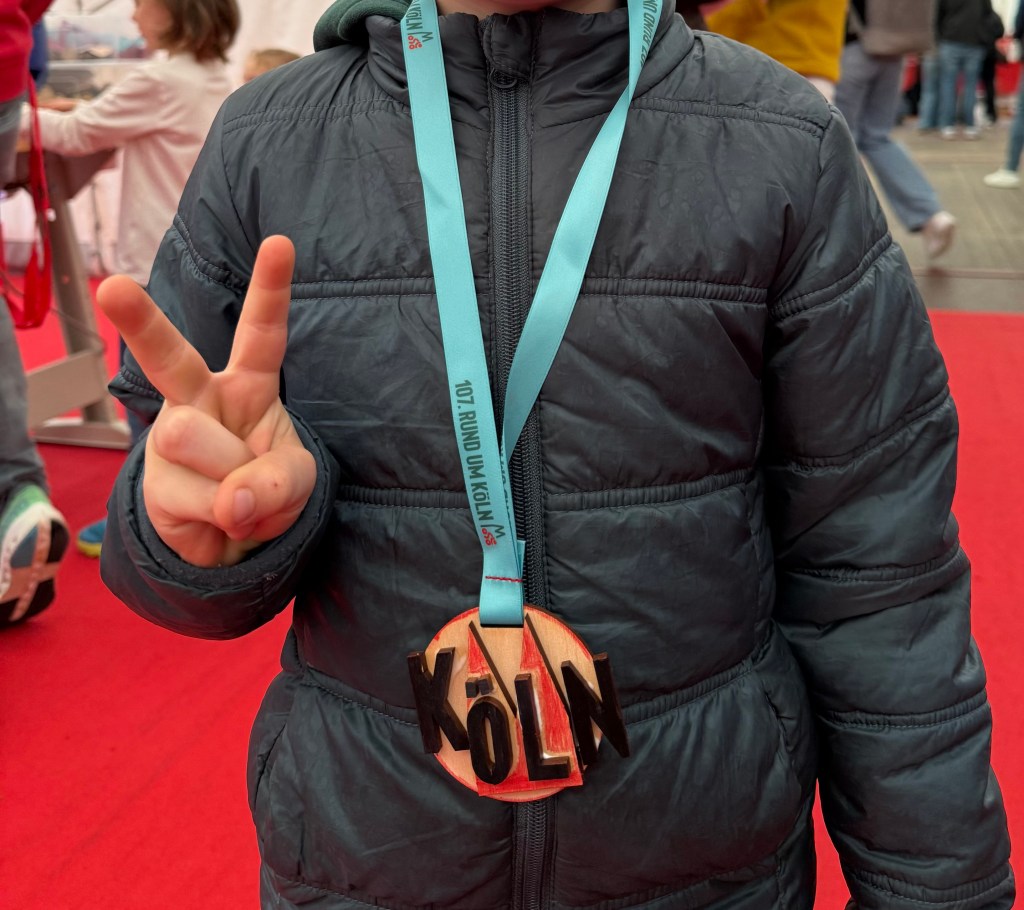
I admit that I am an expo lover. The Cologne Expo takes place in a racing car museum. The Motorworld Köln/ Rhineland is a cool car museum and has a collection of Michael Schumacher, the Formula One race car driver, memorabilia. (Find out More: Motorworld Köln/Rhineland). The expo is big and they speak excellent English if needed. One unique feature is a place for kids to build their own race medals out of wood and ribbons. I’ve never seen this anywhere else and my German friends loved this area.
Pro Tip 2: I always go to the expo the first day it is open, if possible. No advantage unless you are buying lots of stuff, just my personality disorder kicking in.
Chapter Two: The Course
At 2000 years old, Cologne is one of the oldest major cities in Germany. Here is some Cologne trivia. The city of Cologne was once a Roman Colony founded in 38 BC and the name of the city comes from the Roman word for colony, “Colonia.” It was named by the wife of Emperor Claudius, Agrippina the Younger, to honor her birthplace. The name Cologne is the English/ French spelling and it is Köln in German. The city has had numerous governments of the centuries including the Romans, the Franks, a Free Imperial City, the French (1815), the Prussians, the German Empire, West Germany, and Germany. The city has a unique German dialect called Kölsch, which can be hard to understand, especially if you don’t speak German. Here’s a great Kölsch phrase if you sign up to run a marathon.
Kölsch for Marathoners: Et hätt noch immer jot jejange.
(Standard German: Es ist noch immer gut gegangen.) — Things have always gone well in the end.
The perfume Eau de Cologne, or Kölnischwasser, was developed in the early 1700s as an alternative to heavier French perfumes. The recipe is still a secret but the citrus based formula is still produced today. It was deleted to remind one of Summer mornings in Italy according to one source. Also, at one time the cologne was believed to prevent the Black Death of Bubonic Plague. This may be partially true as citrus oil extracts can repel fleas, which were a leading cause of the spread of the Bubonic Plague. That explains why perfume is also called “Cologne.”
I personally sampled some of the Eau de Cologne and did not contract the Bubonic Plague during the race, so there’s that. But I digress……
The course is flat and passes through various neighborhoods of the city. The crowd support is excellent and the crowd is even around for back of the pack runners. The course is well marked with ample support stations every few kilometers.
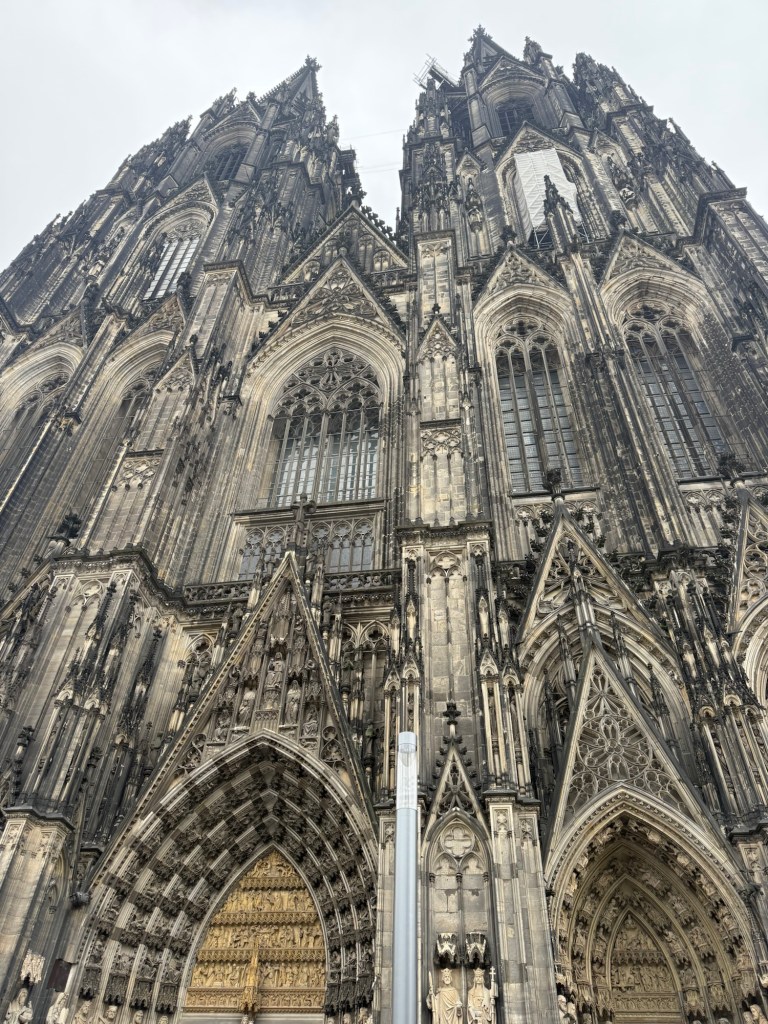
The race ends at the Cologne Cathedral which is an ancient church building which started construction in the twelfth century. The Second World War destroyed much of the city but the church survived.
Chapter Three: What Makes this Race Special
About mile 21 a policeman stepped off the curb in front of me and, smiling, asked, “Sind Sie ein Mann, Raus!” “Are you a man? Hurry!” He and his fellow law enforcement professional then broke into laughter. I don’t normally joke with German police officers since my German is limited. I don’t want to get arrested for using the informal “you” with an officer, which I’m told is a crime. Probably comes from watching too many old movies. I next expected him to tell me that my papers were not in order. I ran on, much faster now, and singing Lili Marlene in German to blend in.
As we approached the last section of the course I was escorted by two ladies through the most difficult part of any marathon: the photographer section. This is where you try to look like you enjoy running so the picture will not make you look like you are a broken down, bad-technique amateur who has no business running a marathon. Ouch.
I explained to the ladies that I was married, but I couldn’t turn back because the police were behind me. That’s my story for my wife and I’m sticking with it.
At last the finish line! Red carpet treatment and a restaurant nearby with real Apple Strudel. The perfect Marathon.
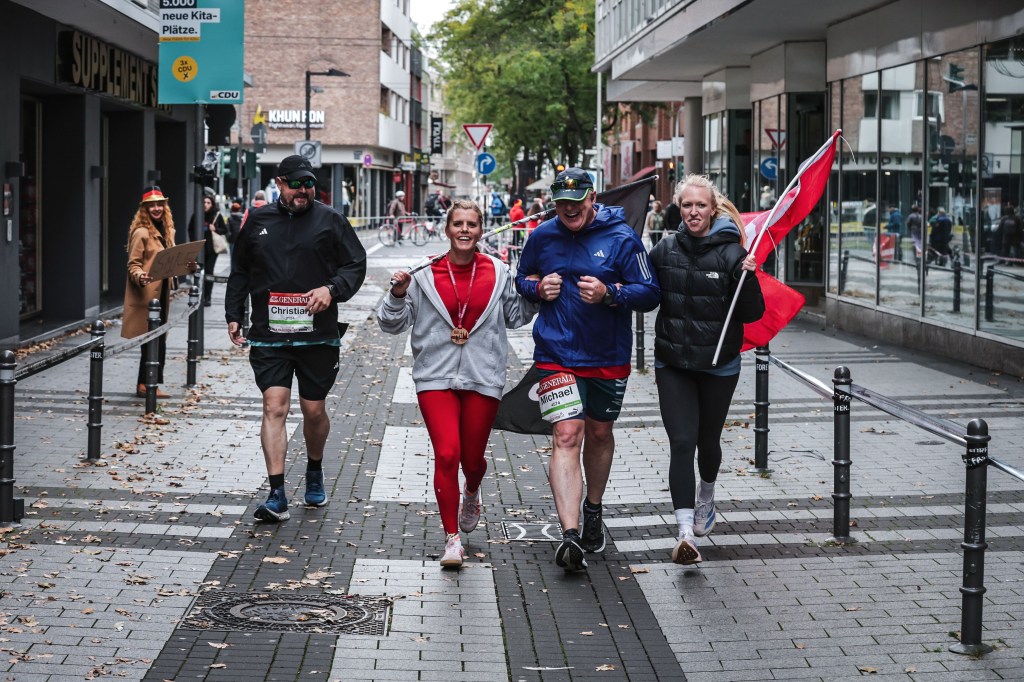


Way to go, brother Mike! We are going to have this framed and give you a copy for Christmas! Lol
Sent from my iPad
LikeLike