
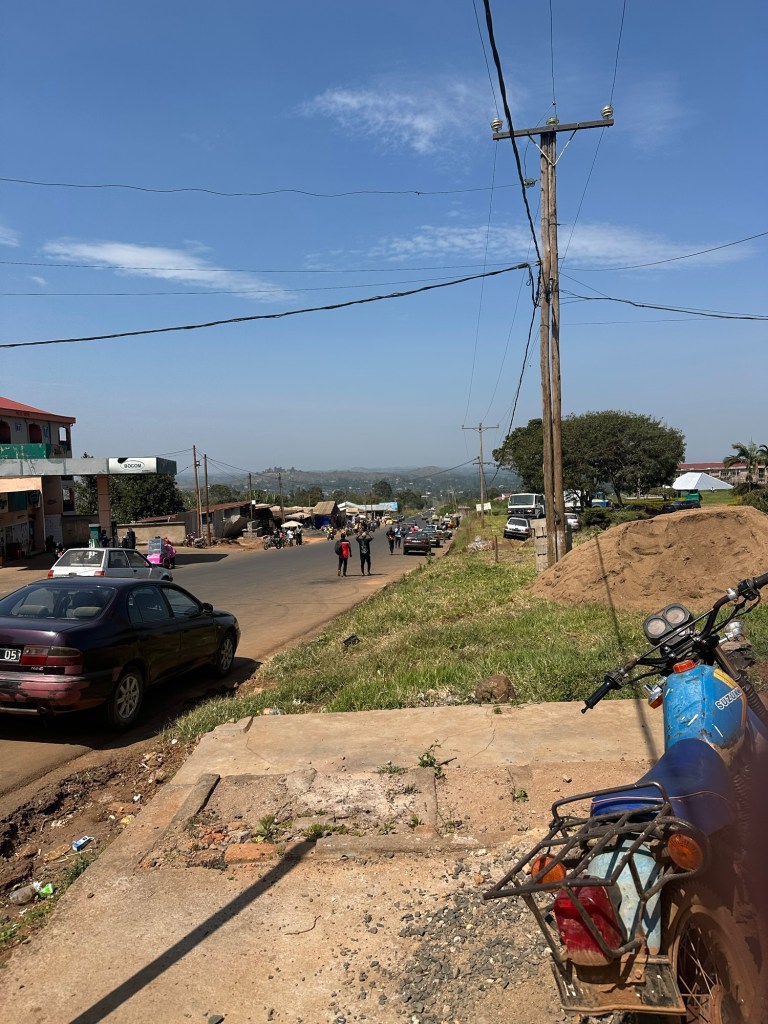
Today started early with breakfast and a walk through part of the city of Bamenda. We are in the area of Bambili in Bamenda which is where the university of Bamenda is located. We were able to meet several friendly shopkeepers and watched a football game (soccer for you Americans) near the university campus.
The Game
The pitch was dusty, hard, dirt except for one section of long grass on the far side. When we arrived the score was 1-1. The skill level was amazing for such a tough surface on which to play. Both teams played a pretty conservative strategy and looked to score on the counterattack. When the ball went into the grass it was interesting to see the players immediately adjust to the different conditions. Good game.
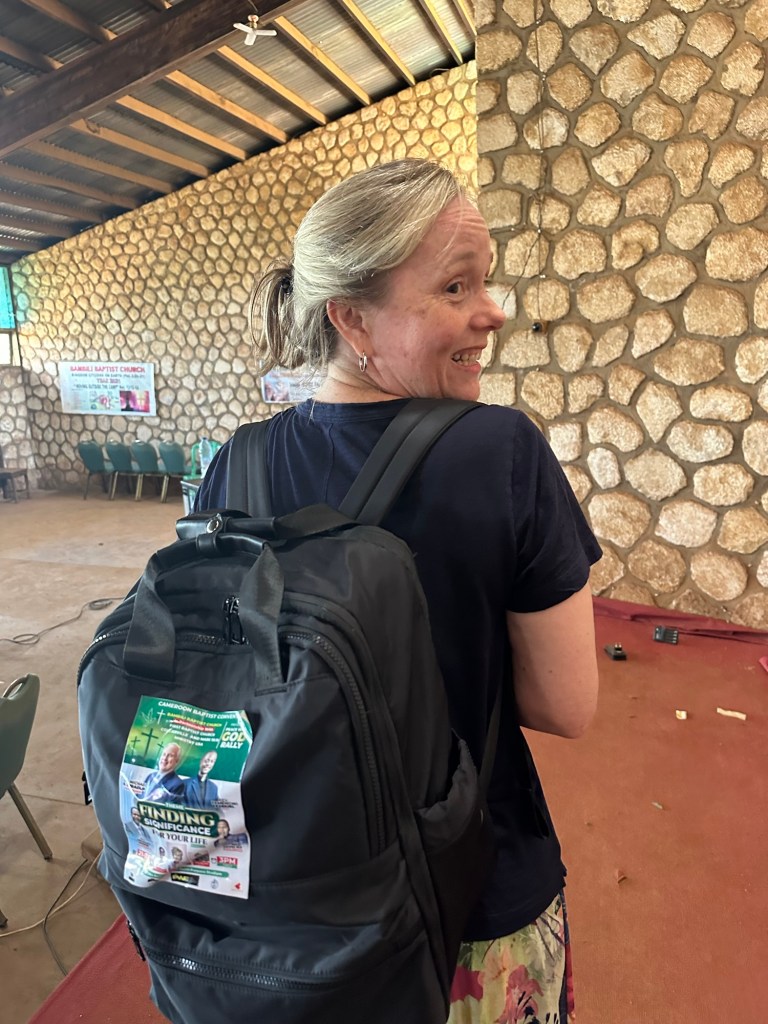
We toured a large church under construction and met several pastors who walked with us as we explored the city. Candi was randomly asking about how promotions to Vice President at the seminary were decided.
We were looking for opportunities to share the Gospel and we found plenty. It was a great day!
Language Tips of the Day:
Well, I did suffer one failure by mispronouncing “hello” in the local dialect but after a good laugh we got it right. What worries me is that I know what I didn’t say since I got it wrong but . . . What did I actually say. . . .
Komtok: Cameroon Pigeon English.
A creole language is a mixture of languages in a simplified form. I was told that three forms of creole, or pigeon are spoken in Cameroon but they are mostly understandable. Creole has long been spoken here and according to Wikipedia (and they are never wrong) the first British missionaries in Bamenda had to learn Creole first before they could start evangelizing.
Examples of Cameroon pigeon (Komtok). It is still a main language of shops and some church services.
- The Pastor di soso tok. ‘The pastor was continually talking.’
- Wi get plenti de go learnam komot dem. ‘We have much to learn from them.’
- The word “ashia” is part of this pidgin and is used to greet, sympathize, or appreciate someone.
Some local dialects of the area are Mbili (Bambili) and Mbui (Bambui). These are dialects of Grassfields Bantu Language. It is debated as to whether some of the dialects are separate languages or variations of an older parent language.
Bambili
A bi wah – is it daybreak? It is asked as a question but functions as “hello.” (This is the phrase I totally messed up).

Last year is South Korea I was with two friends, a husband and wife, and we were walking in busy downtown Seoul. When a crowd of people wanted to pass us, Grace would say what sounded like “Yabo” and Joseph would step aside. I thought it was the Korean word for “move over.” Later Joseph and I were walking and some people wanted to pass us so I said “yabo.” Joseph turned on his heel and glared at me saying, “Why did you call me that?” I said I thought it meant “move over,” but he said, “No, it means “Honey” so don’t call me that in public again.”
Yes, dear.
Somewhere in Africa,
M
 Michael R Spradlin